
Dynamic Reflections: Probing the Hidden Structure of Video Representations
A paper explainer on video-text alignment, richer test-time inputs, and the limits of temporal understanding.

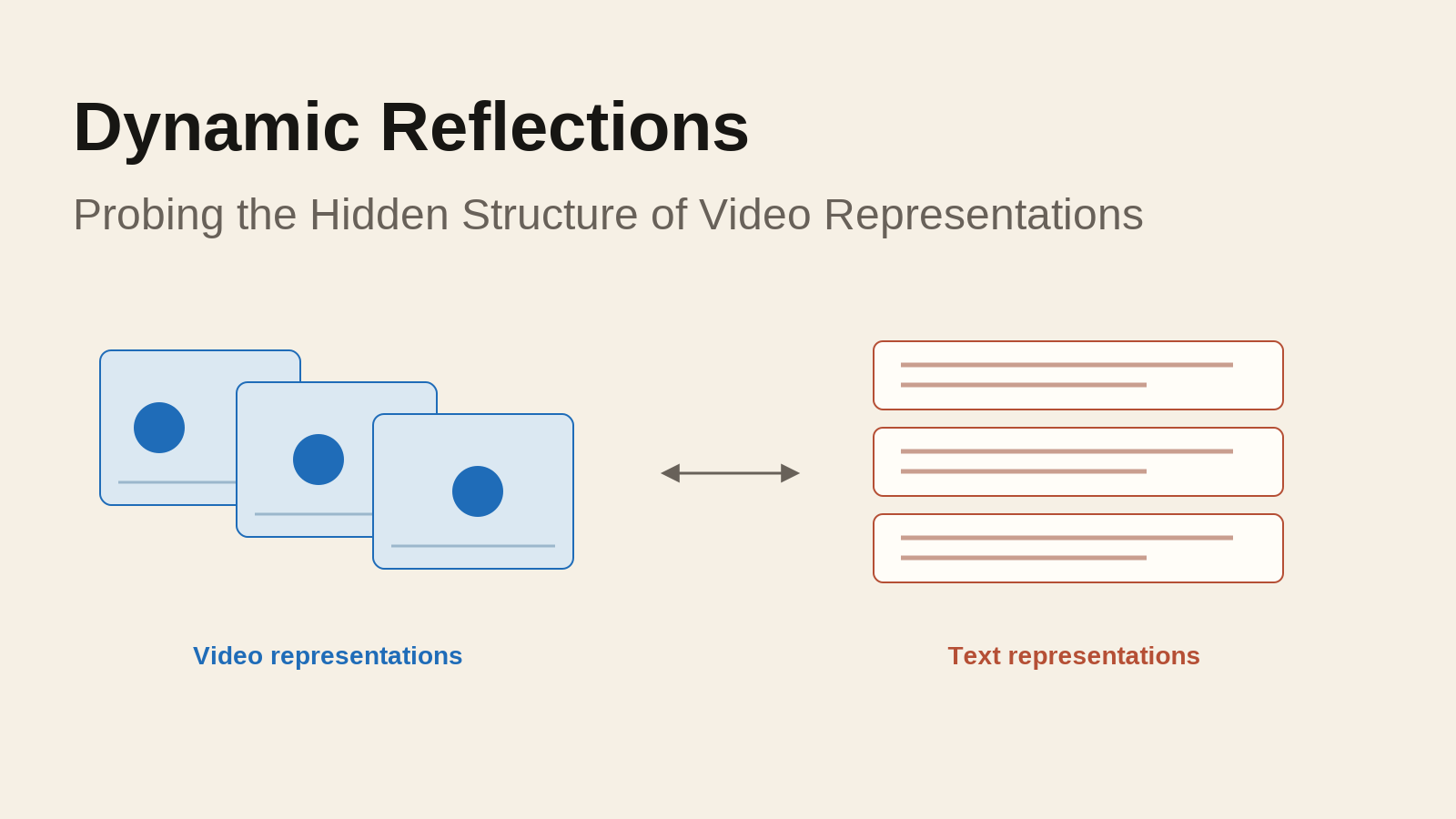
Dynamic Reflections, by Zhu and colleagues, examines how video and language representations align as the inputs become richer. More frames and more captions can improve measured alignment without changing model weights. I explore the paper and a course implementation, including what the alignment metric reveals and where temporal understanding remains weak.
The cave, and the score nobody could read
The Platonic Representation Hypothesis (Huh et al., 2024) says that neural networks trained on different data and different modalities drift toward a shared statistical model of reality. Images and text are two shadows on the cave wall. As models grow, their shadows should start to agree.
The evidence so far came from static data: one image, one caption. The best score on the alignment metric was about 0.16, and the original authors asked openly whether that number means strong alignment or a large gap still to explain. The metric can reach 1, so 0.16 is hard to read.
This paper asks two things. Does the hypothesis hold for video, where motion and time are part of the signal? And is 0.16 low because the models are different, or because one frame and one sentence are a thin sample of what they know?
How alignment is measured
The metric is mutual k-nearest-neighbours. It needs no training and no shared coordinate system, only a dataset of paired videos and captions.
Encode every video with a vision model and every caption set with a text model. The two spaces have different dimensions, so distances cannot be compared directly.
In each space, find every item's k nearest neighbours.
Score the overlap: the fraction of neighbour relationships that both spaces agree on. If video A sits next to video B, do caption A and caption B sit next to each other too?
A(X, Y) = (1 / kN) · Σᵢ Σⱼ (M_X ⊙ M_Y)ᵢⱼ
The study evaluates 1,024 paired samples from VATEX and from the Perception Encoder Video Dataset, using k = 10 for the neighborhood comparison. For each encoder pair, it chooses the layer pair with the highest alignment score. The full study examines 121 vision and language models.
Richer test-time inputs change the score
The central result is about test-time data. Without touching any weights, the paper varies how much each model sees: more frames per video, and more captions per video. Alignment rises with both. With several frames and the full set of captions, scores approach 0.4, up from the 0.16 range.
Captions matter a lot. Because each VATEX caption comes from a different annotator, ten captions cover more of the scene and also more ways of describing it. A linear fit across models puts the gain from one caption to ten at about 60 percent. When a dataset has only one long caption, splitting it into ten shorter ones with an LLM works too. The synthesised captions beat the original on the Perception Encoder dataset, and the gain flattens around six.
Frames matter most for models built for video. A self-supervised video model, VideoMAEv2, turns extra frames into alignment much more efficiently than an image model like DINOv2. The paper also finds that VideoMAEv2, which never saw text during training, reaches the best alignment among the self-supervised models, ahead of DINOv2.
The text encoder matters too. In the study, Gemma 2 models provide a useful reference for probing alignment with vision encoders, although this is a result for the evaluated models and datasets.
A scaling law you can drag
The authors fit a saturation curve to how alignment grows with frames (nf) and captions (nc):
Fit quality is high: R² of 0.9791 for VideoMAEv2 and 0.9964 for DINOv2. The fitted constants below come from the paper. Move the sliders to see where each model sits.
Predicted alignment with Gemma 2 on VATEX
For these fitted encoder pairs, DINOv2 saturates faster as frames are added, while VideoMAEv2 continues to gain alignment over a wider range. The caption terms are similar. This describes the fitted curves; it does not prove that averaging image embeddings captures motion or temporal order.
Alignment as a cheap probe
Evaluating a video model usually means training a decoder per task. The paper tests whether alignment with a text model predicts downstream performance instead. For self-supervised video models, it does:
| Downstream task | Correlation with text alignment |
|---|---|
| Action classification (SSv2, Kinetics) | Strong positive |
| Camera pose, depth, box tracking | Significant, even though these tasks have nothing to do with language |
| Point tracking | Weak. The task is very local, and the authors read this as room for better general-purpose encoders |
If this holds up, a small held-out set and one text model can give an early read on a video encoder, before the expensive evaluations.
Time is the weak spot
Two temporal tests show how much room is left. On the synthetic Test of Time set (captions like "a red circle appears after a blue circle"), the language models rank neighbours like a bag of words: the caption with the same words in a different order lands closest. On VideoComp, where negatives are the same events in a shuffled order, alignment drops only slightly, and the most aligned models drop the most. That suggests they have picked up some temporal structure that the shuffle disturbs, but not much.
The paper also reports that many pure video models lose to image models run frame by frame, and that generative video models align weakly with text so far.
My course implementation
For my course presentation I built a Colab pipeline around this idea, aligning Gemma 2 and DINOv2 embeddings across video datasets, then refactored it into modules. The repository holds the notebook, the refactored code, the slides and the paper.
colab_run_pfinal.ipynb, the notebook runrefactored_modules/, the pipeline split into reusable modulesgen_ai_presentation_final__.pptxandpaper.pdf, the presentation and the paper
Read the source
The alignment results and fitted constants discussed here are from the published study. My course implementation is a separate exploration, rather than an independent reproduction of every reported result. The study provides official code the paper a project page
References
- Zhu, T., Han, T., Guibas, L., Pătrăucean, V., & Ovsjanikov, M. (2026). Dynamic Reflections: Probing Video Representations with Text Alignment. ICLR. Read source
- Huh, M., Cheung, B., Wang, T., & Isola, P. (2024). The Platonic Representation Hypothesis. ICML. Read source
Want to share your own experience? Every member can write here: reach out and we'll help you publish your first post.