
BanglishCheck
Explainable AI-generated text detection for Banglish.
- Najmun Nahar Hira

- Banglish NLP
- AI Text Detection
- Explainable AI
- TF-IDF
- Logistic Regression
- Gradio
- FastAPI
Understanding the score
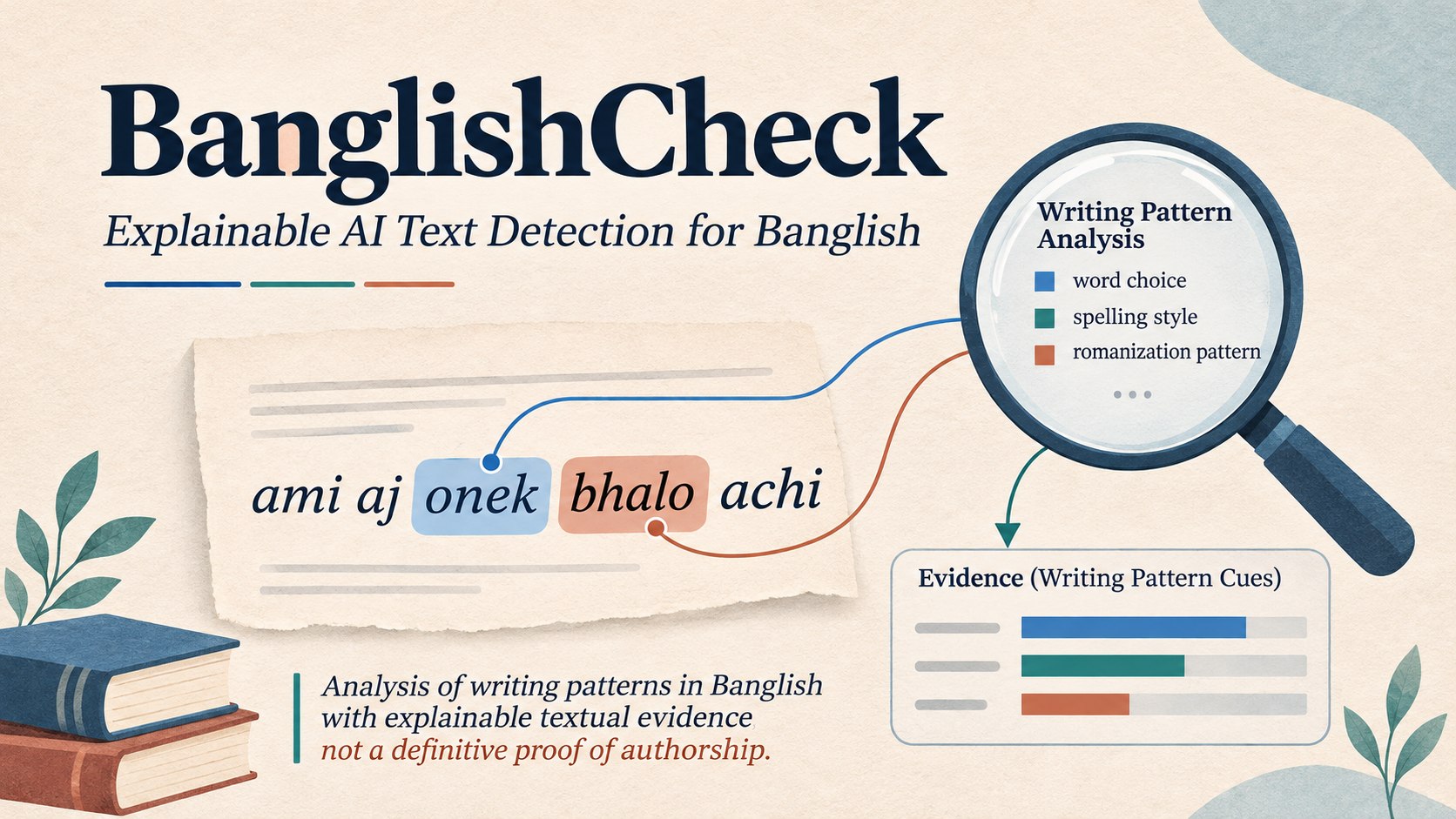
Banglish is Bangla written in Latin letters, often mixed with English. Its flexible spelling and informal style make it a challenging setting for AI text detection. BanglishCheck explores this problem with a detector that shows the writing patterns behind its predictions.
Created by Najmun Nahar Hira, the project combines an AI authorship estimate with highlighted words and a chart of writing-style signals. The aim is to help people examine the evidence behind a score and understand where the detector may be uncertain.
What you can explore
- AI and human text scores. See how closely a Banglish passage resembles the examples learned by the detector.
- Word highlights. Inspect words associated with the model's AI-like and human-like predictions.
- Writing-style signals. Explore the influence of punctuation, spelling variants, emoji, word length, and language switching.
- Short-text feedback. A notice identifies inputs that are too short for a reliable estimate.
How it works
The detector combines word and character TF-IDF patterns with 14 writing-style features, then uses logistic regression to estimate whether a passage resembles human-written or AI-generated text. Its explanation layer maps feature contributions to word highlights and a separate style chart.
The evaluation dataset brings together 1,638 human-written Banglish e-commerce reviews from BanglishRev and 1,638 reviews generated with ChatGPT, Claude, and Gemini. The preparation pipeline removes duplicate texts, samples human reviews to approximate the generated texts' length distribution, and separates the data for training, validation, and testing.
Evaluation highlights
In Hira's evaluation on an evenly balanced test set of 492 Banglish reviews, the combined detector achieved:
The evaluation also compared length, style, word, and character baselines. Character features alone reached 97.4% accuracy, while the combined model adds writing-style evidence to the interface. The technical report includes the full comparison.
Where the limits matter
These results concern Banglish e-commerce reviews. Performance on chats, essays, social posts, paraphrased text, and human-edited AI writing has not been established. Very short passages and unfamiliar writing styles can produce unreliable estimates.
Generator coverage also matters. When Claude was excluded from training, the reported AI detection rate fell to 61%, using a threshold chosen to flag at most 5% of human validation reviews. That threshold does not guarantee the same false-positive rate on new text.
The score is an estimate, not proof of authorship. Word highlights explain patterns used by the detector and should be interpreted alongside the text and its context.
Built with
Python, pandas, NumPy, scikit-learn, TF-IDF, logistic regression, Gradio, matplotlib, and FastAPI. The project includes a Gradio interface for Hugging Face Spaces and a standalone FastAPI interface.
Explore the interactive demo, browse the code, read the technical report, or watch the project walkthrough.