
Why AI Text Detectors Struggle with Banglish
A small experiment on 200 Banglish reviews shows how English-focused classifiers and a multilingual perplexity baseline can misread code-switched writing.

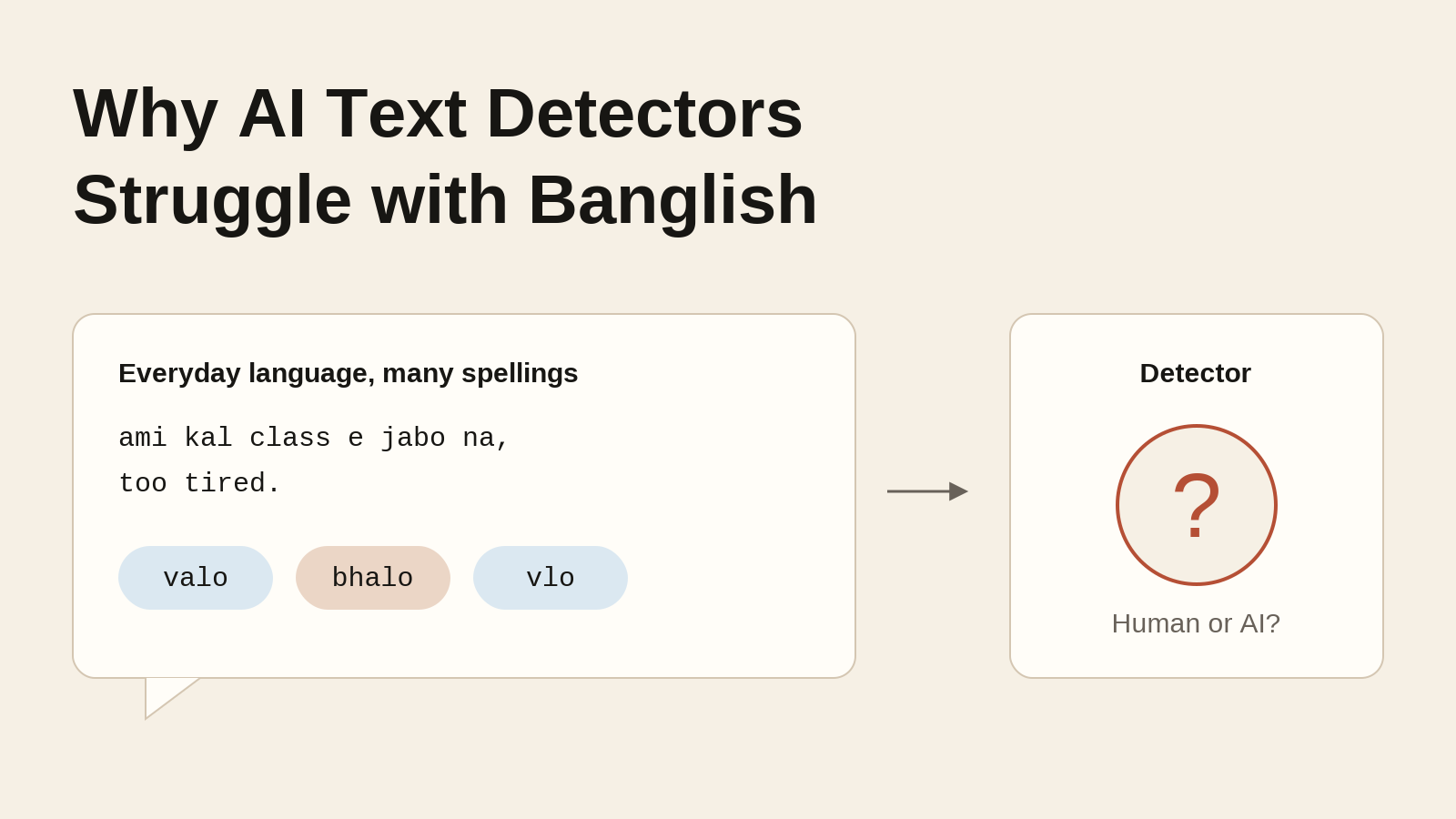
ami kal class e jabo na, too tired. keu notes ta share korte parba?
Read that message again and ask yourself: did a person write it, or did an AI?
If you grew up in Bangladesh, the message looks completely ordinary. It is Banglish: Bangla written in the Roman alphabet, often mixed with English. We use it in Messenger chats, Facebook comments, shopping reviews, and class group chats every day. Large language models such as ChatGPT and Gemini can produce Banglish too, and it can be hard to tell their output apart from ours.
This matters whenever a detector is used to judge real people's writing. A score that works on one language or writing style may fail on another. In this post, I explain several detection approaches and why Banglish challenges them, then test three decision rules on 200 Banglish reviews. In this small experiment, all three scored at or below the 50% accuracy of an always-human prediction, and one flagged 71 out of 100 human reviews as AI-written.
1. How AI text detectors decide
Most detectors fall into one of three families.
Statistical detectors
A language model assigns probabilities to tokens, the pieces of text it reads. Text it finds predictable has low perplexity; surprising text has high perplexity. Some detection methods use the tendency of model-generated text to favor likely continuations. Human writing can contain unusual wording, typos, slang, and sudden topic shifts, but those tendencies depend on the model, language, topic, and generation settings.
Early tools such as GLTR (Gehrmann et al., 2019) visualized token ranks. Later approaches include DetectGPT (Mitchell et al., 2023), which examines probability curvature under text perturbations, and Binoculars (Hans et al., 2024), which contrasts scores from two related language models. These are different statistical methods, not simply interchangeable perplexity thresholds.
Trained classifiers
The second approach is supervised learning. You collect human-written and AI-generated texts, then fine-tune a model such as RoBERTa to tell them apart. A classifier may perform well on familiar data while failing on a different language, domain, or generator.
Watermarking
The third approach puts the task on the generator. While producing text, a watermarked model can favor tokens in a pattern that a matching detector later checks. This tests for a particular embedded signal. An absent watermark does not establish that a person wrote the text, and an unwatermarked generator leaves no such signal to check.
What they have in common
Statistical scores and trained classifiers depend on a model's learned language patterns or on its training examples. Watermarking instead depends on a generator using the matching scheme. The two trained classifiers tested below are English-focused; their model cards do not establish performance on Banglish.
2. What makes Banglish different
Code-switching
Banglish speakers switch languages mid-sentence, sometimes in the middle of a phrase: "meeting ta postpone hoye geche, so kal free achi." A model trained mainly on English, or mainly on Bangla script, may represent this mixture differently from the text on which it was evaluated. How much Banglish a particular model saw during training is often unclear.
No fixed spelling
Banglish has no single fixed spelling: valo, bhalo, vlo, and vhalo can express the same word. These variations are common in everyday writing. They can challenge a detector whose training data does not represent that range.
Tokenization
Before a model reads text, a tokenizer splits it into pieces. I compared three versions of the same message: "I won't go to class tomorrow, I'm too tired." in English, a Bangla-script version, and "ami kal class e jabo na, too tired." in Banglish.
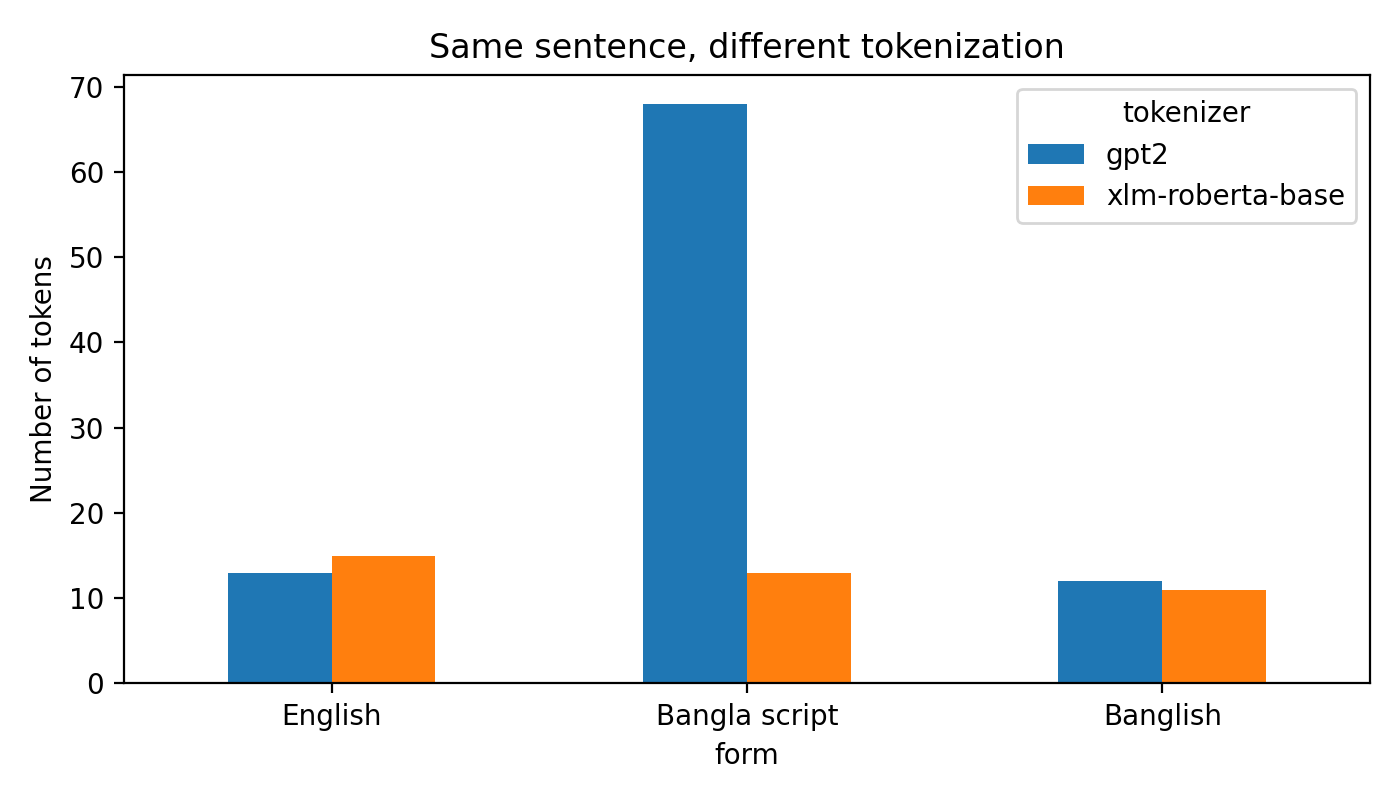
| Writing form | GPT-2 (English-focused) | XLM-R (multilingual) |
|---|---|---|
| English | 13 tokens | 15 tokens |
| Bangla script | 68 tokens | 13 tokens |
| Banglish | 12 tokens | 11 tokens |
GPT-2 needed 68 tokens for the Bangla-script version, compared with 13 for English. Its byte-level tokenizer can split Bangla characters across multiple tokens. XLM-R used 13 tokens for the Bangla-script version.
Banglish used 12 tokens with GPT-2 and 11 with XLM-R. GPT-2 split kal into k + al and jabo into jab + o; XLM-R split jabo into ja + bo. Subword splits are normal and do not by themselves prove a model misunderstands a word. These examples illustrate different representations, rather than demonstrating that tokenization caused the detection errors below.
Very little data
Limited evaluation on Banglish leaves an open question about detection reliability. Liang et al. (2023) found frequent false positives on non-native English essays. That study did not test Banglish, but it gives a reason to examine errors across writing communities rather than assuming an English evaluation transfers.
3. A small experiment
To see whether this happens in practice, I ran a small test.
Setup
Human text: 100 Banglish e-commerce reviews, selected using recorded dates before 30 November 2022. That predates ChatGPT's public release and reduces one contamination risk; a timestamp alone cannot prove that no earlier automated system contributed to a review.
AI text: 100 Banglish product reviews, 50 from Gemini and 50 from ChatGPT, generated on similar shopping topics such as delivery, quality, price, and refunds.
Detectors:
- ChatGPT-RoBERTa (HC3), a RoBERTa classifier trained on human and ChatGPT answers.
- OpenAI's older GPT-2 output detector, a RoBERTa classifier trained to distinguish GPT-2 output from human text.
- BLOOM-560m as a multilingual perplexity baseline: texts below the pooled sample median count as AI. This is a simple decision rule built on a language model, rather than a pretrained detection classifier.
Metrics: accuracy, false-positive rate (human text flagged as AI), and false-negative rate (AI text passing as human)
The Colab notebook contains the experiment code and saved outputs. The experiment repository also includes the aggregate results and figures.
Results
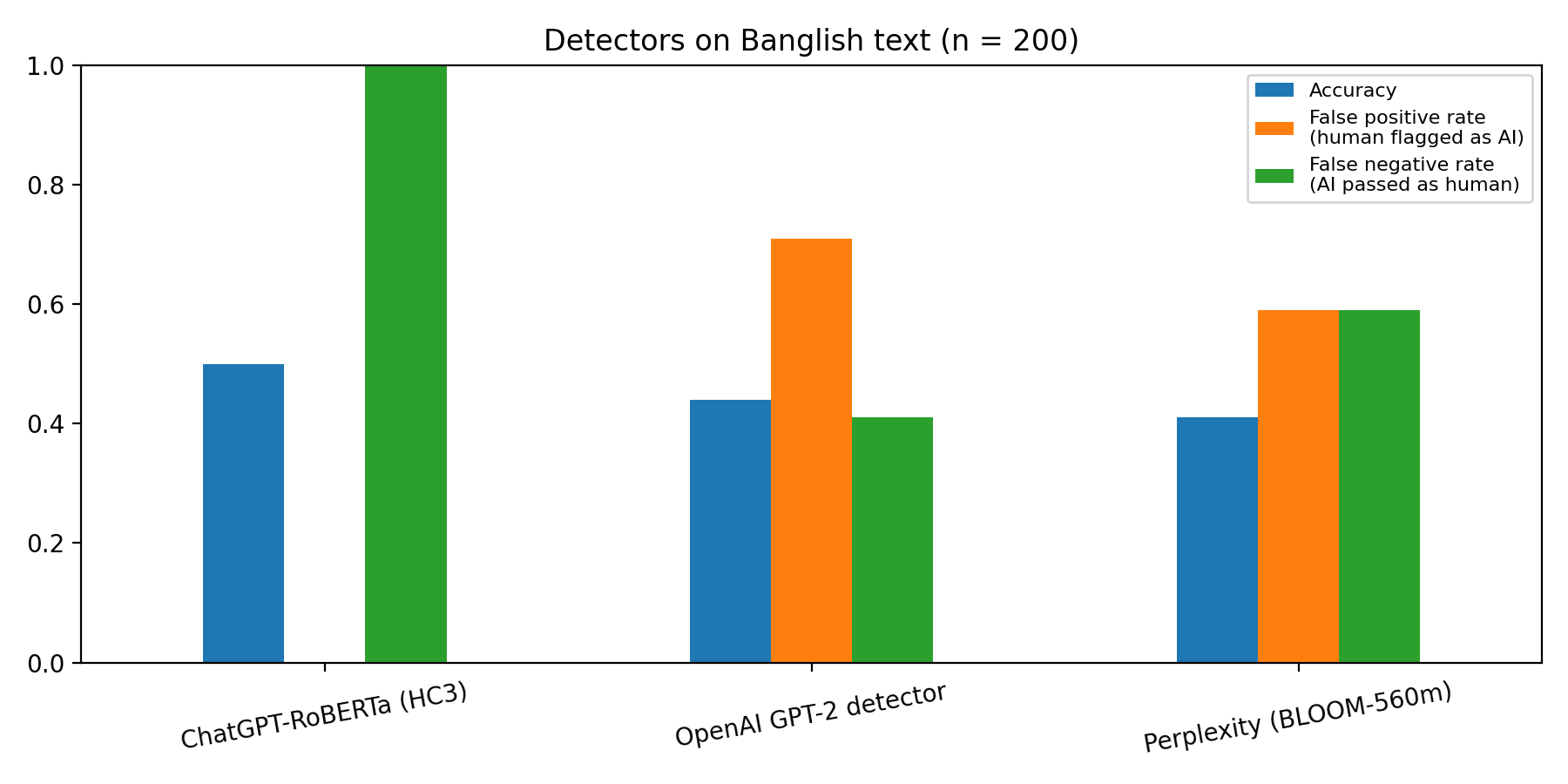
| Detector | Accuracy | Human flagged as AI | AI passed as human |
|---|---|---|---|
| ChatGPT-RoBERTa (HC3) | 50% | 0% | 100% |
| OpenAI GPT-2 detector | 44% | 71% | 41% |
| Perplexity (BLOOM-560m) | 41% | 59% | 59% |
With equal numbers of human and AI texts, an always-human or always-AI rule gets 50% accuracy; fair random guessing has the same expected accuracy. The observed accuracies here were 50%, 44%, and 41%. That describes this sample and these decision rules, rather than establishing that every detector is equivalent to chance.
The ChatGPT detector labeled all 200 texts as human, so its 50% accuracy came entirely from the balanced sample. It missed all 100 AI reviews. Good performance on its original English evaluation would not prevent this kind of failure on Banglish.
The GPT-2 detector flagged 71 of the 100 human reviews as AI. Meanwhile, it let 41 of the 100 AI reviews through as human. In this sample, a human review was more likely to receive an AI label than an AI review was. The model was designed to detect GPT-2 output, so ChatGPT and Gemini reviews also test a change in generator.
The perplexity baseline also failed under its lower-perplexity-means-AI rule. The reported group medians went in the opposite direction:
| Group | Median perplexity |
|---|---|
| Human reviews | 3,655 |
| Gemini | 4,290 |
| ChatGPT | 10,930 |
Human reviews had lower median perplexity than either AI group. One possible explanation is a mismatch between the language model's learned patterns and the generated review style, but these summaries do not identify the cause. The ChatGPT texts were also shorter, with a reported median of 9 words versus 14 for the human reviews. Length is a potential confound that needs a controlled comparison; shorter text does not universally imply higher perplexity.
Breaking the results down by generator shows the same pattern:
| Generator | ChatGPT-RoBERTa | GPT-2 detector | Perplexity |
|---|---|---|---|
| Gemini, passed as human | 100% | 38% | 42% |
| ChatGPT, passed as human | 100% | 44% | 76% |
Where the detectors went wrong
Here are four examples from the GPT-2 detector. The AI score is the classifier's output for its AI label, expressed as a percentage. It is not a verified probability of authorship on Banglish.
| Text | Actually written by | AI score |
|---|---|---|
| "onek onek valo ....onek comfortable...but Ami life a first time nilam tai vul size order kore felchi tai akto tight hocche..." | Human (2022 review) | 99.8% |
| "Alhamdulillah original ta paici Thanks a lot😊❤️ Rider er behavior o valo cilo❤️" | Human (2022 review) | 99.6% |
| "Bhaia er theke taka dhar niye shopping e gelam, ekhon dekhchi amar budget er theke double lagche." | Gemini | 0.8% |
| "New earbuds er sound clarity khub impressive, call quality o bhalo." | ChatGPT | 0.7% |
The two reviews labeled human contain repeated words, trailing dots, emoji, and a personal story about ordering the wrong size. Both received very high AI scores. Meanwhile, a clean, slightly generic ChatGPT sentence about earbuds scored under 1%. These confident scores disagree with the texts' source labels.
I can only hypothesize why. Repeated words and unusual spellings might trigger patterns learned during GPT-2 detection, but testing that explanation would require controlled examples or feature analysis. A confident output alone does not explain the model's decision.
Limitations
This is a small diagnostic experiment, with several limits:
- It uses 200 samples, three decision rules, and one domain. It does not establish performance for Banglish writing as a whole.
- The ChatGPT texts are shorter than the other groups. Length, topic, and writing style may affect perplexity and classifier scores.
- The human reviews date from 2018 to 2022, while the AI texts were generated in 2026. Time, generator, and human-versus-AI labels are therefore entangled.
- The perplexity threshold is the median of the same 200 texts being evaluated. It was not chosen on a separate validation set. Changing the threshold or score direction requires fresh evaluation on held-out data.
- Commercial detectors such as GPTZero were not tested. The public notebook and aggregate tables do not include the full text samples, which limits independent reproduction.
These results show failures worth investigating. They are not a final verdict on every detector or every possible threshold.
4. What could work better
Multilingual models trained on Banglish. Models such as XLM-R and mBERT provide multilingual representations. Fine-tuning on representative, labeled human and AI Banglish is a direction to test. Any improvement needs evaluation on held-out writers, topics, and generators.
Banglish-specific features. Possible signals include language switching, spelling consistency, and vocabulary variation. Some examples suggest that generated Banglish can differ from customer writing, but those differences can also reflect topic or review length. Combining interpretable features with a neural model is an approach to evaluate, rather than a guarantee of reliable detection.
Explainability. A detector that only outputs "99.8% AI" gives a person little basis for questioning its reasoning. Methods such as SHAP and Integrated Gradients can attribute a model score to words or features. Those attributions can help inspect shortcuts, such as an association between unusual spelling and an AI label. They still need validation, and they explain a model's behavior rather than proving who wrote the text.
This is the direction explored in my technical project, BanglishCheck: Explainable AI-Generated Text Detection for Banglish.
5. Conclusion
- A detector's language, domain, and generator assumptions matter. Evaluation on English does not establish reliability on Banglish.
- On these 200 reviews, three decision rules scored between 41% and 50% accuracy. One missed every AI text; another flagged 71% of the human reviews.
- Representative data, careful multilingual evaluation, and validated explanations are useful directions for further work.
If you write in Banglish, your everyday style is part of the variation a detector needs to handle. A detector score alone should not settle a judgment about a writer. You can inspect the decision rules and saved results in the companion notebook.
References and experiment
- Gehrmann, S., Strobelt, H., & Rush, A. M. (2019). GLTR: Statistical Detection and Visualization of Generated Text. ACL System Demonstrations. Read source
- Mitchell, E., Lee, Y., Khazatsky, A., Manning, C. D., & Finn, C. (2023). DetectGPT: Zero-Shot Machine-Generated Text Detection using Probability Curvature. ICML. Read source
- Hans, A., et al. (2024). Spotting LLMs With Binoculars: Zero-Shot Detection of Machine-Generated Text. ICML. Read source
- Liang, W., Yuksekgonul, M., Mao, Y., Wu, E., & Zou, J. (2023). GPT detectors are biased against non-native English writers. Patterns. Read source
- Krishna, K., Song, Y., Karpinska, M., Wieting, J., & Iyyer, M. (2023). Paraphrasing evades detectors of AI-generated text, but retrieval is an effective defense. NeurIPS. Read source